Hotel Revenue
How Hotels Can Generate More Revenue From Existing Guests
· By Nokrach Gerard Trevor
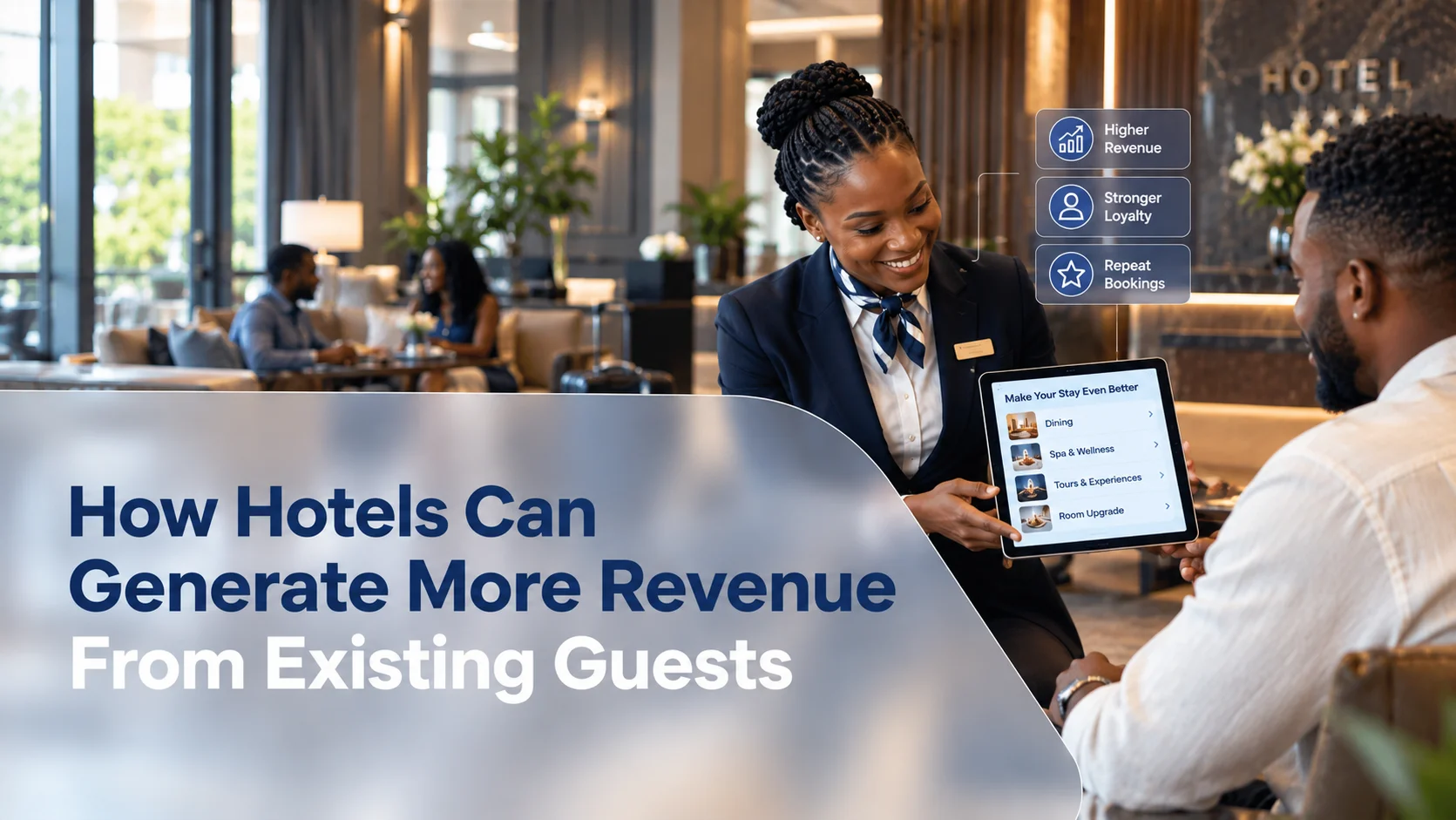
Guests may be interested in breakfast, room upgrades, airport transfers, spa treatments, dining, or other services the property offers. Yet if they do not know these options exist, cannot find the relevant information, or receive no follow-up after expressing interest, the hotel may miss a sale it was already well positioned to make.
A hotel can have fully booked rooms and still miss opportunities to generate additional revenue.
Guests may be interested in breakfast, room upgrades, airport transfers, spa treatments, dining, or other services the property offers. Yet if they do not know these options exist, cannot find the relevant information, or receive no follow-up after expressing interest, the hotel may miss a sale it was already well positioned to make.
This is why learning how to increase hotel revenue from existing guests is about more than raising room rates or attracting additional bookings. It is about making the most of the guest relationships a hotel already has.
The opportunity starts with the services available at the property. Hotels then need to make those services visible, present relevant offers at appropriate moments, follow up consistently, deliver what guests accept, and measure the commercial results.
Here are the practical steps hotel managers can use to build that process.
Start with the services the hotel already offers
Before promoting anything, identify what the hotel can actually sell.
Many properties have revenue-generating services beyond accommodation. Depending on the hotel, these might include:
Room upgrades and premium room categories.
Breakfast, restaurant meals, and dining packages.
Spa and wellness treatments.
Airport transfers and private transport.
Early check-in and late check-out.
Tours, experiences, and activities.
Meeting-room services and event add-ons.
These services represent potential hotel revenue opportunities, but their existence alone does not guarantee sales. Guests need to know about them, understand their value, and have a convenient way to purchase them.
Start by creating a service inventory. For each service, record its description, price, availability conditions, booking process, and the team responsible for delivery.
For example, a hotel offering airport transfers should know the price, service area, vehicle availability, booking requirements, and person responsible for confirming each request.
This preparation helps prevent a common problem: promoting an offer that staff cannot fulfil or that has unclear pricing.
Practical tip: Begin with three to five services that have clear prices, reliable availability, and a straightforward fulfilment process. It is easier to test and improve a small number of well-defined offers than to promote every service at once.
For more context, see our guide to [ancillary revenue opportunities in hotels]([ADD BLOG 1 URL]).
Make guests aware of relevant services
Guests cannot purchase services they do not know about.
A hotel may have a restaurant, wellness facility, or transport service, but guests might never discover it during their stay. Staff may be busy, information may be scattered across different channels, and service details may not be presented when guests are ready to make a decision.
Hotels can address this by making service information clear and accessible.
Consider using:
Pre-arrival messages that explain relevant services.
Clear service menus with prices and booking instructions.
Reception and in-room information.
Restaurant and facility information at appropriate guest touchpoints.
Direct responses when guests ask about available services.
Follow-up messages when a guest has expressed interest in an offer.
The goal is not to send every guest a long list of everything the hotel sells. It is to help guests discover options that may improve their stay.
For example, a guest arriving late may appreciate knowing whether dinner is available. Someone planning an early departure may find airport transport information useful. A guest staying several nights may be interested in a dining or wellness option.
Clear descriptions also matter. Instead of simply saying “premium dining available,” explain what the package includes, when it is available, and how much it costs.
Identify moments when an offer is useful
The value of an offer depends partly on when it is presented. A relevant service can be ignored if it arrives too early, too late, or at a moment when the guest has other priorities.
Hotels should map their offers to the guest journey.
Before arrival
Guests may be planning transport, considering room options, or deciding whether to add breakfast. This can be an appropriate time to communicate useful services and allow enough time for arrangements.
During arrival and check-in
Guests may need information about dining, available room options, or practical services. Any offer must fit the arrival experience and avoid delaying essential check-in tasks.
During the stay
Once guests have settled in, they may discover new needs or decide to use additional facilities. Offers can be relevant when they reflect the guest's circumstances and the service is available.
When planning dining or transport
Specific needs often create clear opportunities. A guest asking about a restaurant or airport transfer has already signalled an interest that staff can respond to directly.
Before departure
Late check-out may be useful to some guests, provided the hotel can accommodate it. Other guests may need transport arrangements or information about a future stay.
Timing should always be guided by service availability and guest context. Hotels should also establish sensible contact limits so that relevant communication does not become message overload.
Replace inconsistent manual follow-up with a process
One of the most difficult problems in hotel upselling is not identifying an opportunity. It is making sure that the opportunity receives consistent follow-up.
A guest might ask about a spa appointment, enquire about a room upgrade, or show interest in a transfer. If the relevant employee becomes busy or the request is passed between departments without a clear owner, the opportunity can be lost.
A simple process can reduce this risk.
1. Record the enquiry or offer. Capture the service requested, the guest's interest, and any information required to respond.
2. Assign responsibility. Identify the person or department that must confirm availability, answer questions, or arrange the service.
3. Set a follow-up rule. Decide when to respond, what information is needed, and when another message is appropriate.
4. Confirm the guest's decision. Record whether the guest accepted, declined, requested more information, or did not respond.
5. Close the loop. Ensure accepted offers reach the responsible team and that the guest receives the service promised.
This process does not eliminate the need for human judgement. Staff should remain responsible for situations that require clarification, special arrangements, or an operational decision.
The objective is to make follow-up dependable rather than leaving it to memory or individual initiative.
Use targeted campaigns for groups of guests
Not every revenue opportunity starts with an individual guest enquiry. Hotels can also communicate suitable offers to a defined group of guests.
There is an important distinction between individual upselling and targeted campaigns.
Individual upselling begins with a particular guest's context or expressed interest. For example, a guest asking about a transfer may receive information about the available transport service.
Targeted campaigns begin with an audience and a relevant offer. For example, a hotel may promote a seasonal dining package to an appropriate group of previous guests or communicate a new service to guests whose circumstances make the offer relevant.
Campaigns can help hotels make services more visible without relying entirely on staff to introduce each one manually.
However, segmentation matters. A promotion should have a clear audience, an appropriate time window, accurate terms, and a defined response path. A campaign should not become a reason to send irrelevant messages to every contact in the hotel's database.
Hotels should also respect guest communication preferences and applicable privacy requirements.
Ensure accepted offers are fulfilled
An accepted offer is not the end of the process.
If a guest purchases an airport transfer but the driver is not informed, or books a dining package that the restaurant does not prepare, the hotel has created an operational problem instead of a better guest experience.
Fulfilment should therefore be part of the revenue process from the beginning.
For every offer, define:
Which team receives the confirmed request.
What information that team needs.
Who verifies availability and special conditions.
How payment or room-account charges are handled.
How the hotel confirms that the service was delivered.
How cancellations, changes, or failed fulfilment are recorded.
This is particularly important when an offer involves several departments. A dining package might involve guest communication, reservations, the restaurant, and the payment process.
The hotel should be able to trace an offer from the original communication through acceptance and delivery to the resulting transaction.
Measure revenue rather than messages sent
Sending more offers does not automatically mean generating more revenue. Hotels need to understand which offers produce completed sales and whether the results justify the effort and cost.
A useful measurement process follows the entire journey.
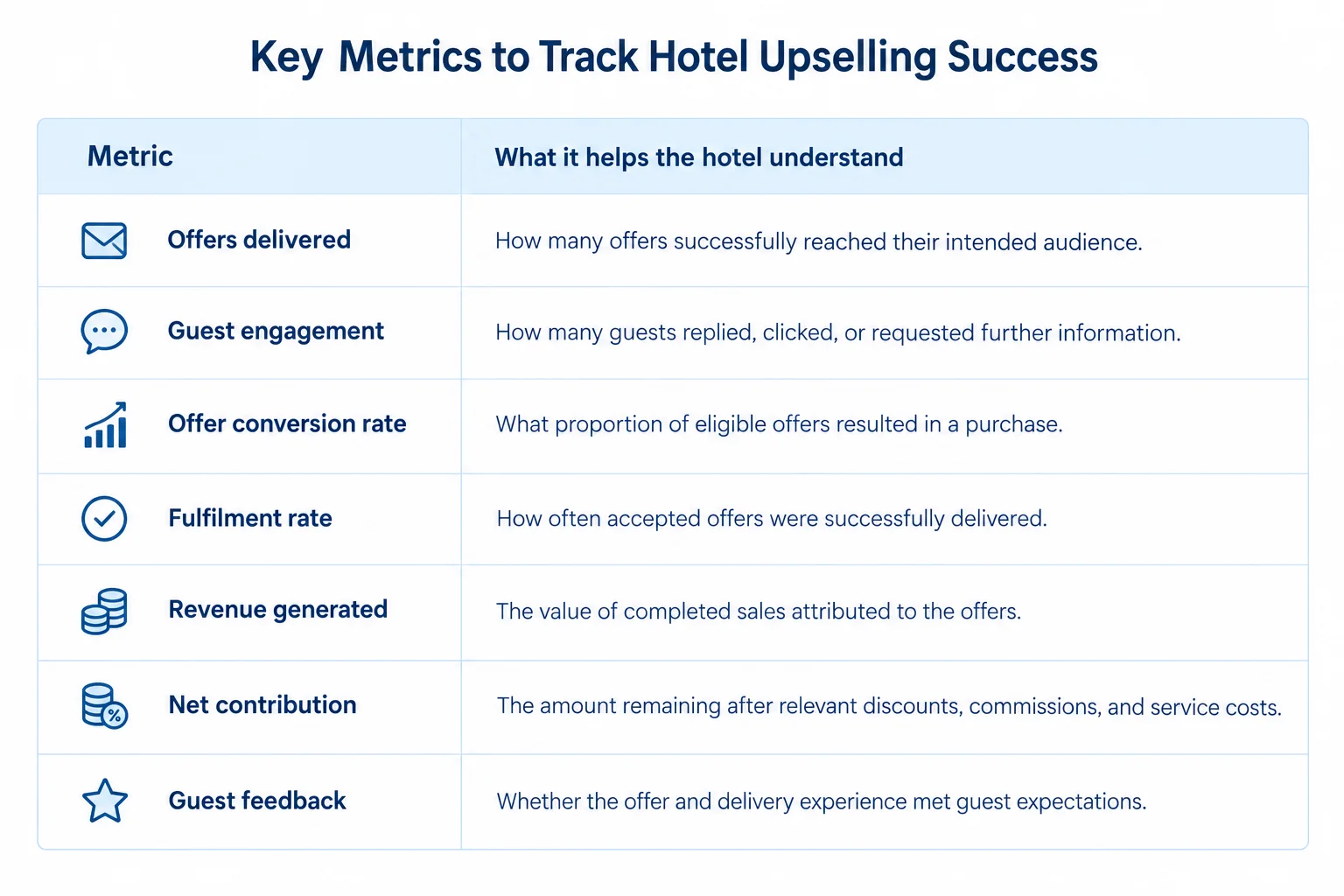
For example, a dining promotion might generate many enquiries but few completed bookings. That could indicate unclear pricing, unsuitable timing, limited availability, or a mismatch between the audience and the offer.
Another offer might receive fewer responses but produce more completed sales and stronger net contribution. Measurement helps managers decide which services deserve more attention.
Hotels should also establish a baseline before evaluating changes. Without knowing the starting position and tracking comparable periods, it is difficult to determine whether a new approach has improved results.
The objective is to understand the relationship between guest engagement, service delivery, and revenue, not simply to count messages.
A practical 30-day starting plan
Hotels do not need to redesign every commercial process at once. A controlled pilot can help identify the most promising opportunities and reveal operational problems before the approach expands.
Week 1: Audit services and capacity
List existing services, prices, availability conditions, fulfilment requirements, and responsible departments. Identify gaps in the information needed to promote each service confidently.
Week 2: Choose priority offers
Select three to five services with clear guest value and reliable delivery. Define the audience for each offer, the appropriate timing, the price to communicate, and the result to measure.
Week 3: Run a controlled pilot
Test the offers with a suitable audience. Make sure staff understand their responsibilities, guest responses are recorded, and accepted services are delivered. Keep communication relevant and within approved contact rules.
Week 4: Review and improve
Compare the results across offers. Review engagement, conversion, completed fulfilment, revenue, costs, and guest feedback. Identify what worked, what failed, and what should change before expanding the programme.
At the end of the month, management should have a clearer view of which services create viable opportunities, which operational bottlenecks need attention, and what information is still missing.
How HOSCover fits into the process
HOSCover is positioned around helping hotels capture more commercial value from their existing guests and available services.
Rather than treating guest messaging as the end goal, its intended workflow connects guest context and service information to relevant offers, guest responses, operational follow-up, and revenue records.
This addresses a practical challenge for hotel teams: even when services are available, opportunities can be missed because staff are busy, follow-up is inconsistent, and departments do not always share the information needed to complete a sale.
HOSCover is designed to support individual guest upselling as well as targeted campaigns for groups of guests. The commercial objective is to help hotels make appropriate offers, connect accepted requests to fulfilment, and understand the results.
The value of this approach should be evaluated through a hotel's actual operating results. Hotels considering revenue software should verify the available capabilities, integration requirements, operational workflow, and reporting before committing to a solution.
Start identifying your hotel's revenue opportunities
Your hotel may already have services that guests would value but do not consistently discover or purchase. The first step is to identify those services and build a dependable process for presenting, fulfilling, and measuring relevant offers.
Use a guest-revenue opportunity assessment to review your current services, identify gaps in guest awareness and follow-up, and choose the opportunities worth testing first.
If you want to explore how a more systematic approach could support this process, discover HOSCover's hotel revenue and guest-engagement solution or arrange a demonstration to discuss your hotel's needs.
The goal is straightforward: make more value available to the guests you already serve, while protecting the quality of their experience and the reliability of your hotel's operations.