'%20d='m0%200h2048v2006h-2048z'%20fill='%23FEFEFE'/%3e%3cpath%20transform='translate(689,256)'%20d='m0%200h173l28%201%201%20427%20339%201v-428l41-1h173l32%201v1041h-102l-76-26-45-15-19-6-4-1v-394l107-36%2032-11%203-1v-2l-4%201-28%201h-575l-17-1%2010%205%2043%2014%2062%2021%2026%209%201%201v392l-7%203-43%2014-65%2022-30%2010-100%201-1-1v-1041z'/%3e%3cpath%20transform='translate(477,1538)'%20d='m0%200%2012%202%2040%2010%2043%209%2053%2010%2057%209%2035%205%2059%207%2050%205%2080%206%2095%204h131l6-1%2053-2%2049-3%2065-5%2065-7%2047-6%2065-10%2056-10%2048-10%2054-13h3v52l-19%205-54%2012-35%207-57%2010-54%208-56%207-48%205-71%206-73%204-32%201h-170l-49-2-78-5-57-5-63-7-58-8-51-8-54-10-64-14-23-6z'/%3e%3cpath%20transform='translate(541,1436)'%20d='m0%200%2056%2013%2039%208%2043%208%2052%208%2053%207%2068%207%2069%205%2043%202%2050%201h115l69-3%2068-5%2042-4%2051-6%2049-7%2043-7%2048-9%2037-8%2030-7%2011-3h3l-1%2053-49%2011-65%2013-56%209-60%208-54%206-61%205-98%205h-154l-96-5-49-4-48-5-56-7-47-7-35-6-33-6-73-16-4-2z'/%3e%3cpath%20transform='translate(602,1342)'%20d='m0%200%208%201%2024%206%2047%2010%2044%208%2052%208%2055%207%2076%207%2051%203%2046%202h101l56-2%2073-5%2061-6%2054-7%2056-9%2048-9%2044-10%2016-4h4v52l-52%2012-42%208-34%206-64%209-35%204-51%205-72%205-27%201-52%201h-57l-52-1-44-2-67-5-50-5-70-9-53-9-36-7-46-10-11-3-1-1z'/%3e%3cpath%20transform='translate(960,426)'%20d='m0%200h72l1%201v74h-73z'/%3e%3cpath%20transform='translate(1088,426)'%20d='m0%200h72l1%2027v47l-1%201h-72l-1-2z'/%3e%3cpath%20transform='translate(961,303)'%20d='m0%200h71l1%201v72l-73%201v-73z'/%3e%3cpath%20transform='translate(960,550)'%20d='m0%200h72l1%201v72h-73z'/%3e%3cpath%20transform='translate(1088,303)'%20d='m0%200h72l1%203v70l-73%201z'/%3e%3cpath%20transform='translate(1088,550)'%20d='m0%200h72l1%202v70l-1%201h-72l-1-72z'/%3e%3cpath%20transform='translate(874,1040)'%20d='m0%200%204%202v71l-1%201h-9l-1-1v-72z'%20fill='%23FEFEFE'/%3e%3cpath%20transform='translate(1243,1040)'%20d='m0%200%2010%201%201%201-1%2072h-10z'%20fill='%23FEFEFE'/%3e%3c/svg%3e)
Hotel Revenue
What Is Ancillary Revenue in Hotels? Examples and Opportunities
· By Nokrach Gerard Trevor
Hotels earn most of their core revenue from selling rooms, but the guest experience can create opportunities to generate income from other products and services.
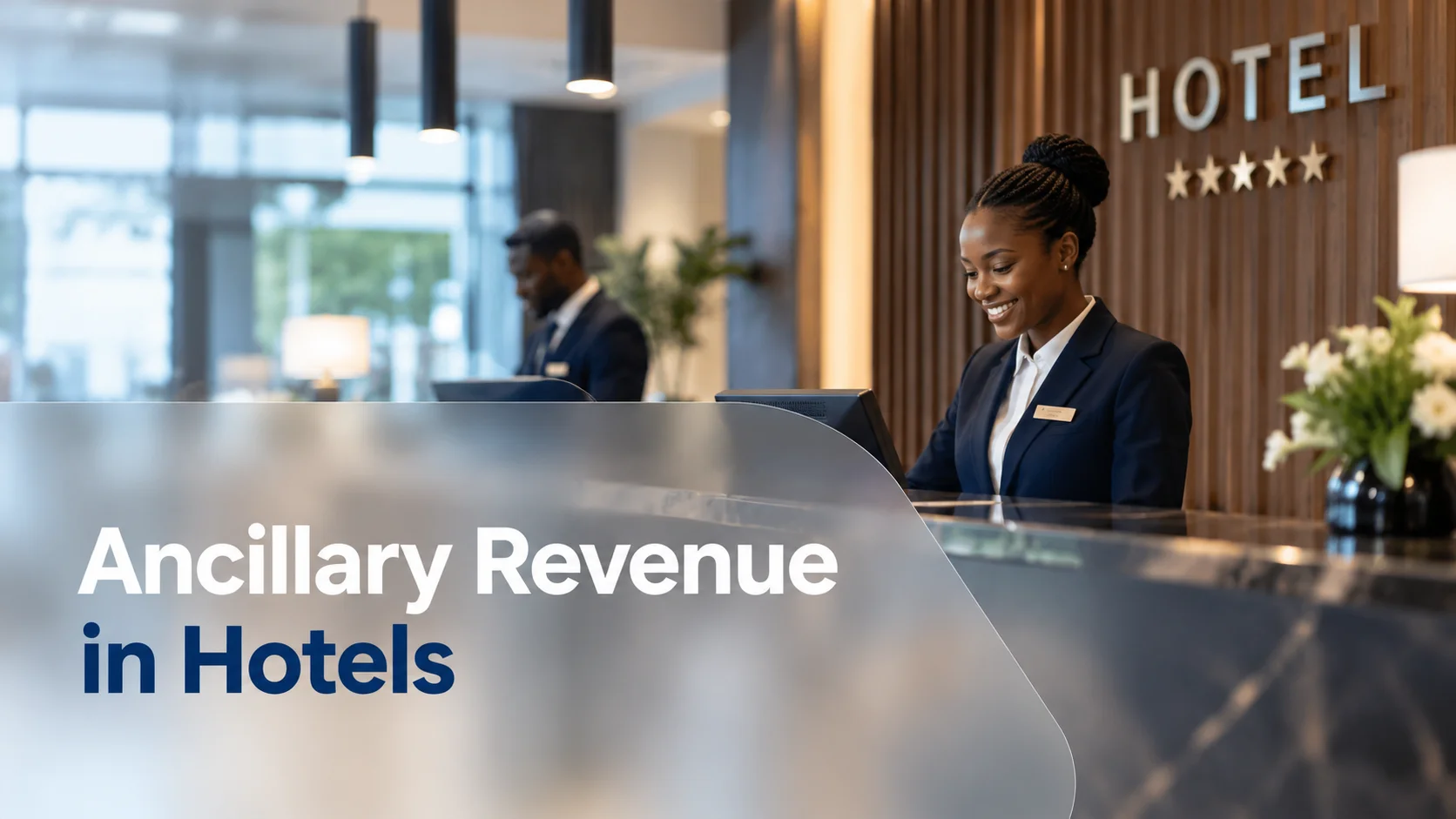
Hotels earn most of their core revenue from selling rooms, but the guest experience can create opportunities to generate income from other products and services. From room upgrades and restaurant bookings to spa treatments and airport transfers, these additional revenue streams can help hotels make better use of the services they already offer.
Understanding hotel ancillary revenue helps hotel owners, general managers, and revenue managers identify opportunities to increase revenue, improve service discovery, and deliver more value to guests without relying exclusively on room sales.
In this guide, we explain what ancillary revenue means, explore common examples, and outline practical ways hotels can identify, promote, and measure these opportunities.
What Is Ancillary Revenue in Hotels?
Ancillary revenue in hotels is income generated from products and services beyond the core sale of a guest room. Depending on the property, it can include food and beverages, room upgrades, spa treatments, airport transfers, tours, meeting facilities, and other additional services.
For example, a guest might book a standard room and later pay for an upgrade, order dinner at the hotel restaurant, or book a guided excursion through the property's concierge. Each purchase can contribute to the hotel's ancillary revenue.
The available opportunities vary by property. A full-service resort may generate revenue from wellness facilities, restaurants, and activities, while a smaller city hotel may focus on breakfast packages, transfers, early check-in, and late check-out.
The objective is not simply to sell more. It is to help guests discover relevant services that improve their stay while creating additional revenue opportunities for the hotel.
Why Does Ancillary Revenue Matter for Hotels?
Ancillary revenue gives hotels additional ways to generate income from their existing guest base. It can also help properties make better use of their facilities, staff, and service offerings.
1. Generate more revenue from existing guests
Hotels invest resources in attracting bookings, preparing rooms, and welcoming guests. Once a guest has booked, the hotel may have further opportunities to meet that guest's needs through additional services.
For example, a couple visiting for a special occasion might appreciate a romantic dinner reservation or a spa package. A business traveller might value an airport transfer or express laundry service.
When these services are available and relevant, promoting them can create additional sales without requiring the hotel to acquire an entirely new guest.
2. Make better use of existing services
Some hotels have restaurants, wellness facilities, meeting rooms, transport services, or experiences that are not consistently promoted to guests.
A service can be available without being visible. Guests may not know that a spa offers evening appointments or that the hotel can arrange a transfer.
Improving awareness of these services can help hotels identify demand and make better use of existing capacity. However, additional demand must be balanced against staffing, availability, and operating costs.
3. Improve the guest experience
Ancillary revenue and guest satisfaction do not have to compete with each other.
A relevant offer can make a stay more convenient or memorable. For instance, offering a family an available room upgrade or helping a guest arrange transport may solve a genuine problem.
The key is to offer services that match guest needs rather than sending repeated promotions that interrupt the guest experience.
4. Diversify revenue sources
Room revenue remains central to many hotel business models, but additional services can provide other sources of income.
The mix depends on the property's facilities, location, customer segments, pricing, and operating model. Hotels should therefore identify the revenue streams that make sense for their specific circumstances instead of copying another property's strategy.
Common Examples of Hotel Ancillary Revenue
The following table outlines common ancillary revenue opportunities and practical considerations for managing them with operational consideration
Room upgrades
A guest pays to move to a higher room category.
Confirm room availability and the price difference.
Early check-in and late check-out
A guest pays for additional room access where available.
Check housekeeping schedules, arrivals, departures, and room readiness.
Food and beverages
Guests purchase breakfast, restaurant meals, drinks, or in-room dining.
Promote relevant options and confirm opening hours and capacity.
Spa and wellness
Guests book massages, treatments, or wellness sessions.
Coordinate appointment availability and treatment requirements.
Airport transfers
Guests book transport to or from the property.
Confirm timing, vehicle availability, and pricing.
Tours and experiences
Guests arrange local tours, excursions, or activities.
Verify schedules, partner arrangements, and weather or cancellation conditions.
Meeting and event services
Businesses book meeting rooms, equipment, or catering.
Confirm room capacity, equipment, staffing, and event requirements.
State turnaround times, service conditions, and prices clearly.
Not every hotel will offer all these services. Some properties may also earn ancillary revenue through parking, resort activities, equipment rental, pet fees, or other property-specific services.
The best starting point is to review what your hotel already offers, what guests actually use, and which additional services can be delivered profitably.
Why Do Hotels Miss Ancillary Revenue Opportunities?
Hotels can have attractive additional services and still struggle to generate consistent sales from them. The problem is often not a lack of services, but a lack of visibility, timing, coordination, or measurement.
Guests do not know what is available
A guest may spend several nights at a hotel without discovering its restaurant, wellness facilities, or local experiences.
Information may be spread across room directories, printed menus, websites, reception desks, and separate service providers. Guests who cannot find the information they need may simply choose another option.
Hotels can address this by making service information easier to discover before arrival and throughout the stay.
Offers arrive at the wrong time
Timing influences whether an offer is useful.
An airport transfer offer may be relevant before arrival. A restaurant recommendation may be more useful before dinner, while an available late check-out option may be appropriate closer to departure.
Sending every offer to every guest at the same time can reduce relevance. Hotels should consider the guest journey, the service being promoted, and the time required to fulfil a booking.
Staff have limited time to promote services
Front desk and reservations teams often handle check-ins, guest enquiries, complaints, telephone calls, and administrative work.
Although staff may know which additional services are available, they may not have enough time to promote each option consistently to every suitable guest.
Clear processes and appropriate communication tools can help hotels make service information more accessible without placing an unreasonable burden on staff.
Departments work in isolation
A hotel's restaurant, spa, front office, reservations, and marketing teams may use different systems or processes.
Without coordination, a guest might receive an offer for a service that is unavailable, receive conflicting information, or have a request that is not passed to the responsible department.
Hotels need clear ownership of offers, accurate service information, and a reliable process for handling guest responses and bookings.
Results are not measured consistently
A hotel might send promotional messages or advertise an upgrade without knowing how many guests purchased the service or how much revenue the campaign generated.
Without measurement, it becomes difficult to determine which offers work, which guest segments respond, and whether the additional sales justify the cost of delivering the service.
How Can Hotels Identify Ancillary Revenue Opportunities?
Hotels do not need to launch a complicated campaign across every department. A practical approach is to begin with a small number of services, establish how they will be promoted, and measure the results.
Step 1: Audit your existing services
Start by listing the products and services the property can sell beyond the core room booking.
Include room upgrades, dining, wellness, transport, experiences, meeting facilities, and other relevant services.
For each service, document:
The selling price and any applicable conditions.
The cost of delivering the service, where known.
Available capacity and operating hours.
The department responsible for fulfilment.
The guest types most likely to benefit.
How guests currently discover and purchase it.
This audit helps identify services that are ready to promote and highlights information or operational gaps that need to be addressed first.
Step 2: Map opportunities across the guest journey
Think about the stages when a guest might need or appreciate a particular service.
Guest journey stage
Potential opportunity
Example
Before arrival
Prepare for the stay.
Airport transfers, available room upgrades, or a special occasion package.
Arrival
Improve convenience.
An eligible early check-in or information about available hotel facilities.
During the stay
Enhance the experience.
Restaurant reservations, spa treatments, or local experiences.
Before departure
Make departure easier.
An available late check-out or transport arrangement.
After departure
Encourage future engagement.
Relevant return-stay offers or information about future experiences, subject to marketing permissions.
These are examples rather than a universal schedule. Hotels should adapt their offers to their own services, booking patterns, guest preferences, and operational constraints.
Step 3: Match offers to likely guest needs
The same promotion will not be relevant to every guest.
A family may be interested in family-friendly activities, while a business traveller may value laundry services or convenient transport. Guests celebrating an occasion may appreciate dining or wellness options.
Hotels can use appropriate booking context, guest preferences where legitimately available, and previous interactions to make offers more relevant. They should avoid making unsupported assumptions about guests and should respect applicable privacy requirements and communication preferences.
Step 4: Confirm capacity before promoting an offer
Promoting a service that cannot be delivered can damage guest trust and create additional work for staff.
Before launching a campaign, confirm availability, prices, booking procedures, and fulfilment responsibilities. Where availability changes frequently, the process should include a way to verify it before confirming the guest's purchase.
Step 5: Start with a small, measurable test
Select two or three suitable offers rather than promoting everything at once.
For example, a city hotel might test an airport transfer offer before arrival and a restaurant promotion during the stay. It could then compare guest engagement, completed bookings, revenue, and the cost of fulfilling each service.
Use the results to refine the offers before expanding the programme.
How Can Hotels Promote Services Without Overwhelming Guests?
The goal of ancillary revenue promotion is to help guests discover useful services, not to turn every interaction into a sales opportunity.
Choose the right channel
Hotels can promote services through their website, booking confirmation emails, pre-arrival communications, in-room information, reception, concierge teams, and messaging channels such as WhatsApp where appropriate.
The right channel depends on the guest's preferences, the type of offer, and the hotel's communication setup.
Make the offer relevant and timely
A useful message answers three questions: What is being offered? Why might it be useful? How can the guest book it?
For example:
“Would you like to arrange an airport transfer for your departure tomorrow? Our team can help you confirm availability, timing, and pricing.”
This is more useful than a generic promotional message that does not account for the guest's circumstances.
State prices and conditions clearly
Guests should be able to understand the price, what is included, availability restrictions, cancellation conditions where applicable, and how to make a booking.
Clear information reduces confusion and helps staff avoid unnecessary follow-up.
Control message frequency
Avoid sending too many promotions during a guest's stay. Set frequency limits, prioritize essential service communications, and make it easy for guests to decline promotional messages.
Hotels should also follow applicable data protection requirements, channel-specific rules, and consent or opt-out requirements for marketing communications.
Use automation carefully
Automation can help hotels schedule relevant messages, manage repeatable workflows, and reduce manual follow-up. However, automated communication still needs accurate service information, clear responsibility for bookings, and a process for escalating questions or exceptions to staff.
The objective is to reduce repetitive work while preserving the personal service guests expect from hospitality businesses.
How Should Hotels Measure Ancillary Revenue?
To understand whether an ancillary revenue initiative is working, hotels need to track more than the number of messages sent or promotional materials distributed.
A useful measurement process follows the offer from initial communication to completed service delivery.
Metric
What it tells you
Offers delivered
How many intended guests actually received the offer.
Engagement rate
How many guests interacted with the offer, using a clearly defined engagement measure.
Conversion rate
The proportion of eligible recipients or engaged guests who completed a purchase. State which denominator is used.
Completed transactions
How many bookings or purchases were fulfilled.
Ancillary revenue
The revenue generated by the additional services sold during the measurement period.
Average transaction value
The average amount of revenue generated per completed transaction.
Contribution or margin
The financial contribution after relevant service-delivery costs, where the necessary cost data is available.
Hotels should also compare results by service, campaign, guest segment, and period where the data allows. This can reveal which offers are most useful and which services require a different approach.
A simple example
Suppose a hotel promotes an optional transfer service and records 20 completed bookings at $30 each.
The resulting gross ancillary revenue is:
20 bookings × $30 = $600
This is revenue, not profit. The hotel would need to account for transport costs, commissions, staffing, and other relevant expenses to understand the contribution from those bookings.
Likewise, if the hotel wants to know whether a campaign caused additional sales, it should consider what would have happened without the campaign. Comparing results with a suitable baseline or control group can help distinguish genuinely incremental revenue from purchases that would have occurred anyway.
Consistent tracking allows hotels to make better decisions about which services to promote and where to invest their efforts.
How Can HOSCover Help Hotels Explore Ancillary Revenue Opportunities?
HOSCover is positioned as a hospitality revenue and guest-engagement platform that helps hotels communicate with guests and promote relevant offers through channels such as WhatsApp.
For hotels seeking to improve ancillary revenue, the potential value lies in making service offers easier to communicate, supporting guest engagement, and creating a clearer process for connecting promotions with guest responses and purchases.
For example, a hotel might want to communicate an available room upgrade before arrival or promote a relevant restaurant or wellness offer during a stay. A structured guest-engagement process can help the hotel present these opportunities at appropriate moments rather than relying entirely on staff to remember every possible offer.
The value depends on the hotel's service catalogue, data quality, operational processes, and ability to fulfil the offers. Hotels should also confirm which integrations, automation workflows, and revenue-tracking capabilities are supported by the current product before relying on them in a live operation.
The practical starting point is simple: identify the services your hotel can deliver, choose a few relevant offers, and establish how you will measure completed purchases and the revenue they generate.
If you want to explore how structured guest communication could support your hotel's revenue strategy, learn more about HOSCover or request a product demonstration.
Frequently Asked Questions About Hotel Ancillary Revenue
What is ancillary revenue in hotels?
Ancillary revenue is income generated from products and services beyond the hotel's core room sale. Examples include food and beverages, room upgrades, spa treatments, airport transfers, tours, and meeting facilities, depending on what the property offers.
What are examples of ancillary revenue for hotels?
Common examples include paid room upgrades, early check-in and late check-out where available, restaurant and bar purchases, spa services, laundry, airport transfers, tours, activities, parking, and meeting-room hire.
How is ancillary revenue different from room revenue?
Room revenue comes from selling accommodation. Ancillary revenue comes from additional products and services sold to guests or other customers. Both contribute to hotel revenue, but they should be measured separately when the hotel needs to understand the performance of its different revenue streams.
How can a hotel increase ancillary revenue?
A hotel can begin by auditing its existing services, identifying guest needs, improving service visibility, offering relevant promotions at appropriate times, checking availability before confirming purchases, and measuring completed transactions and associated revenue.
How should hotels measure ancillary revenue?
Hotels should record revenue from additional services separately from room revenue and track completed transactions, average transaction value, conversion rates, and relevant delivery costs. Where possible, they should also measure the incremental contribution of specific campaigns.
Does ancillary revenue only apply to luxury hotels?
No. Hotels of different sizes and service levels can generate ancillary revenue. The opportunities will differ: a resort may promote wellness and activities, while a smaller property may focus on transfers, dining, laundry, or room upgrades.
Can technology help hotels generate ancillary revenue?
Technology can support service discovery, guest communication, campaign scheduling, and performance measurement. Its usefulness depends on the capabilities available, the accuracy of hotel data, the relevance of the offers, and the hotel's ability to fulfil guest requests.
Your Next Step: Identify Your Hotel's Revenue Opportunities
You do not need to promote every service at once to begin improving ancillary revenue.
Start with a simple audit of what your property offers, when guests are most likely to need it, how they currently discover it, and how you will measure the outcome.
Use this checklist to assess your hotel's opportunities:
List the additional services your hotel can sell.
Record prices, delivery costs, and availability.
Identify the guest journey stage when each service is most relevant.
Choose two or three offers to test.
Confirm booking, fulfilment, and communication processes.
Track completed transactions and revenue.
Review guest feedback and refine the offers.
Once you understand where the opportunities exist, you can build a more consistent approach to promoting services and measuring the results.
Want to see how HOSCover fits into your guest-engagement strategy? Book a demo to discuss your hotel's needs and explore the product's current capabilities.